Anton Korolkov’s Chain Reaction, from Rehab to the Ukrainian National Football Team
There’s a moment many movement professionals know too well:
A high-level athlete has pain that will not resolve.
The research is conflicting.
The protocols have been applied.
Even surgery has been tried.
And somehow, the situation is worse, not better.
For Anton Korolkov, those moments became a turning point, not a dead end.
Anton has spent years working in rehab, sports science, football rehabilitation, and performance, and since June 2024, he has worked with the Ukraine National Football Team, helping align recovery and preparation across coaching and medical staff. His work blends data-driven performance analysis with hands-on return-to-play implementation, and it’s built on one core mission:
Make decisions that positively change a player’s life or career.
But Anton’s story starts long before elite tournaments and national-team systems. It starts with an injury no one could solve, and a search for something more reliable than “the next best protocol.”
The problem with “having an answer”
Anton’s work centers on footballers, especially those dealing with chronic injuries. He’s drawn to the cases that do not fit neatly inside a template, because that’s often where the real work is.
In his own words, he focuses on “small changes,” adjusting mechanics and movement patterns from local to global, and watching how small local inputs can change the bigger picture. That perspective is not just clinical. It’s personal.
Anton used to be a football player, too, and he had to stop playing because of an injury that no one could help him with. That experience shaped his career path and fueled a deeper question:
What can we rely on when protocols, research, and experience all point in different directions?
That question became even more pressing as he faced higher-stakes cases.
The cases that test your reasoning
Anton describes some of the toughest situations he has faced:
-
Chronic groin pain, surrounded by debate and conflicting research
-
Persistent Achilles pain, where repeated interventions failed to produce lasting change
These were not simple situations, and they were not “local” problems that could be solved by treating the painful tissue in isolation.
In one chronic groin case, the athlete had already undergone surgery, and still could not train or compete without significant limitation. At one point, the athlete could only continue playing with painkillers and injections, which made the situation painfully clear: this was not a sustainable path.
What made these cases so challenging was not only the pain itself, but the uncertainty around it.
And then something changed.
Anton learned to stop fearing those moments, and to start using them.
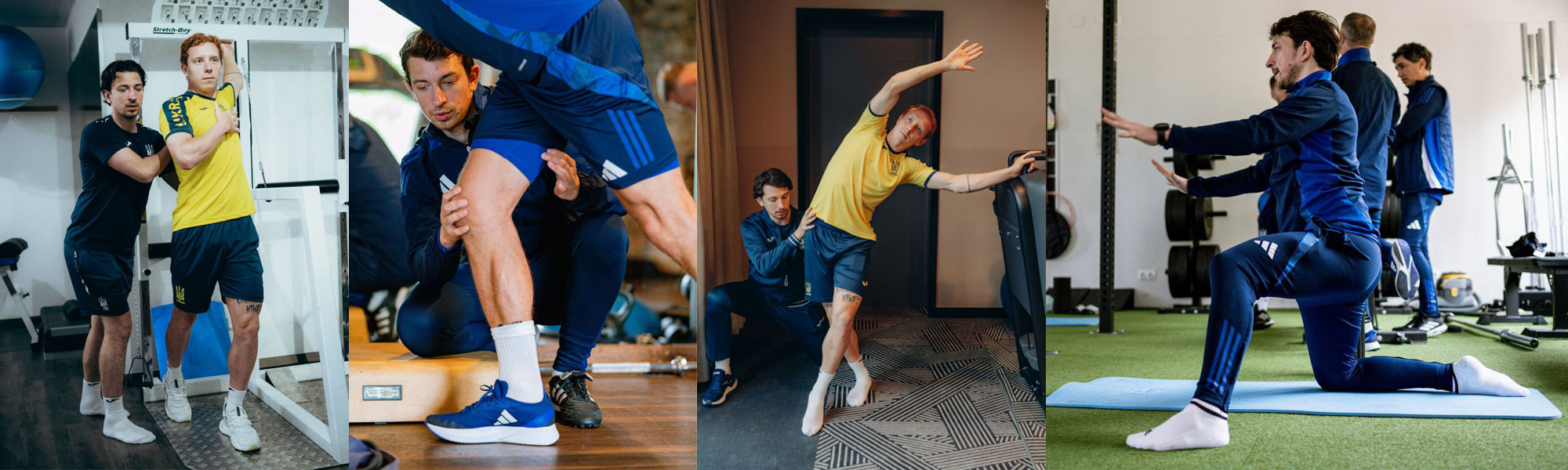
When the case is unclear, start with the person
When the case is unclear and everyone around you has a different opinion, it’s tempting to pick a side and push harder on a plan.
Anton does something different.
He listens to the opinions of the people around him and gathers perspectives, but he starts in one place first:
The person in front of him.
From his experience, the athlete will often “give hints,” willingly or unwillingly, without realizing it, and those hints point you toward where you should investigate next.
“Our main task is not to harm,” Anton says. “That is the foundation we build upon.”
From there, he applies a simple filter that keeps him grounded when the noise gets loud:
Why before what.
He starts with the reason, the pattern, and the purpose, then chooses the intervention, not the other way around.
A different way to think: local, global, and everything in between
Anton’s experience with Gray Institute did not give him a single “solution” for groin pain or Achilles pain.
It gave him something more useful: a process for thinking.
He learned to approach the body and movement with a broader lens, breaking movement down into smaller parts, then rebuilding it step by step, while accounting for the way regions interact.
For Anton, the shift looked like this:
-
From local treatment → to global investigation
-
From isolated structures → to integrated movement patterns
-
From rigid protocols → to principles and strategy
Anton summarizes it as a commitment to “why before what,” especially when the situation is messy and the stakes are high.
In the chronic groin pain case, that meant moving away from the painful area as the “main character,” and instead evaluating how surrounding regions and movement relationships were contributing to the issue.
In the Achilles case, it meant zooming out from the tendon and looking at adjacent regions, movement sequencing, and how the athlete was loading, absorbing, and redirecting force through the system.
Anton summarizes this as a core theme of his work now:
“From local to global, from isolated to integrated.”
Case example: treating the system, not just the symptom
In one case, a footballer had recurring groin pain during running, especially as the leg extended behind the body. Rather than chasing the groin locally, Anton assessed the whole system and found limited thoracic mobility and poor abdominal support during the movement. Once those areas were addressed, the athlete’s symptoms steadily reduced over time, and the recurring pain stopped showing up during running. It was a simple reminder of the principle: when the body is a unified mechanism, the “problem area” is not always the driver.
The mistake he made before he had principles
Anton is quick to say he still makes mistakes, and that he will keep learning for the rest of his life.
But if he had to name the pattern that held him back before he began seeing the body as a unified mechanism, it’s this:
He kept doing the same thing locally, and hoped for a different result.
That’s the trap for many capable movement professionals. You keep applying a local solution with more precision, more intensity, or more frequency, but the outcome does not change because the driver is not local.
This is one reason Anton’s “local to global” lens matters so much.
It is not a buzz phrase. It is an escape hatch from the local loop.
Why Gray Institute felt different
Anton’s first formal step into this world was CAFS (Certification in Applied Functional Science) in 2019. After that, he completed GIFT (Gray Institute for Functional Transformation) in 2023, and later completed FSTT (Functional Soft Tissue Transformation).
But as Anton will quickly tell you, his learning was not confined to a classroom. He gained an “incredible amount” from Gray Institute's free educational resources, including videos that were shared as gifts.
That matters, because it points to something deeper than content.
Anton believes the difference is this:
Gray Institute does not provide ready-made solutions.
Instead, it provides principles, ideas, and strategies, then challenges you to discover the solution for the individual in front of you.
In pain and performance, that approach is not inconvenient. It’s necessary.
Because two people rarely present the same way, even when the diagnosis looks identical on paper.
The real shift: from skepticism to conviction
In an earlier reflection, Anton described how he used to feel uncertainty when he began studying movement:
Should he rely on protocols?
Research?
A popular system?
A mentor’s opinion?
Some things worked. Some didn’t.
But what changed for him was not just an improved toolkit. It was a stronger foundation, and a stronger community.
Anton describes finding a global family of like-minded professionals, and a place where he could build around principles rather than trends. He emphasizes support, shared curiosity, and a commitment to individualization.
And now, that same mindset shows up in the highest levels of sport.
From practice to national-team systems
Anton has been running his own practice for seven years, and his recent professional path reflects a consistent theme: building bridges.
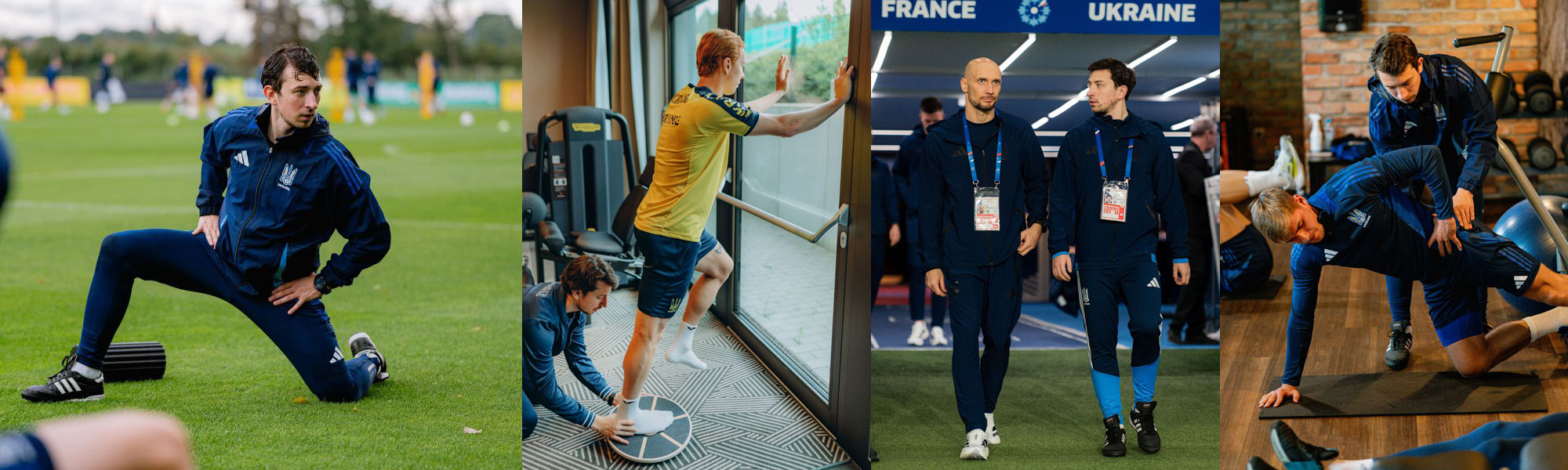
Since June 2024, he has worked with the Ukraine National Football Team, combining load monitoring and performance analysis with return-to-play systems and performance optimization.
From March to December 2025, Anton served as Head of Sport Science at the Ukrainian Association of Football, where he helped implement systemic approaches to recovery and performance across national teams, from U-15 through the senior squad.
He has been part of major tournaments, including UEFA Euro 2024 and UEFA European Under-21 Championship 2025, bringing the same “investigate and rebuild” mindset into environments where decisions affect careers, clubs, national programs, and livelihoods.
And through all of it, Anton keeps coming back to the same core idea:
Every decision should help change a player’s life, career, resilience, and long-term development.
A message for the movement professional reading this
Anton’s story is not just “inspiring.” It’s instructive.
Because the people who benefit most from this education are rarely the ones looking for more exercises.
They are the ones who want:
-
A stronger process for problem-solving
-
A way to navigate complexity when the template fails
-
Principles that hold up across settings, from clinic to performance, from general population to elite sport
-
A community that pushes thinking forward, not a system that hands out one-size answers
If you’ve ever felt stuck between “what the research says,” “what the protocol says,” and “what the person in front of you is showing you,” Anton’s experience offers a clear reminder:
Better outcomes often start with better questions.
If Anton’s story sounds familiar, and you’re ready to sharpen how you think, not just what you do, consider applying for Gray Institute® for Functional Transformation (GIFT).